
Marketing Automation Turns Opportunities into Sales
Lead follow-up, communication, newsletters, reviews and retention
Marketing Automation connected to your website through a single Growth System provides lead follow-up, customer communication, newsletters, review request and retention marketing.
Traffic May Not Be your Biggest Problem
Businesses often assume they need more website visitors, more advertising, or more leads. In reality, the problem often starts after a lead arrives. Missed calls, delayed responses, forgotten follow-ups, and inconsistent customer communication quietly reduce revenue every day. As part of investing in better traffic, it makes sense to make better use of the opportunities coming through your website.
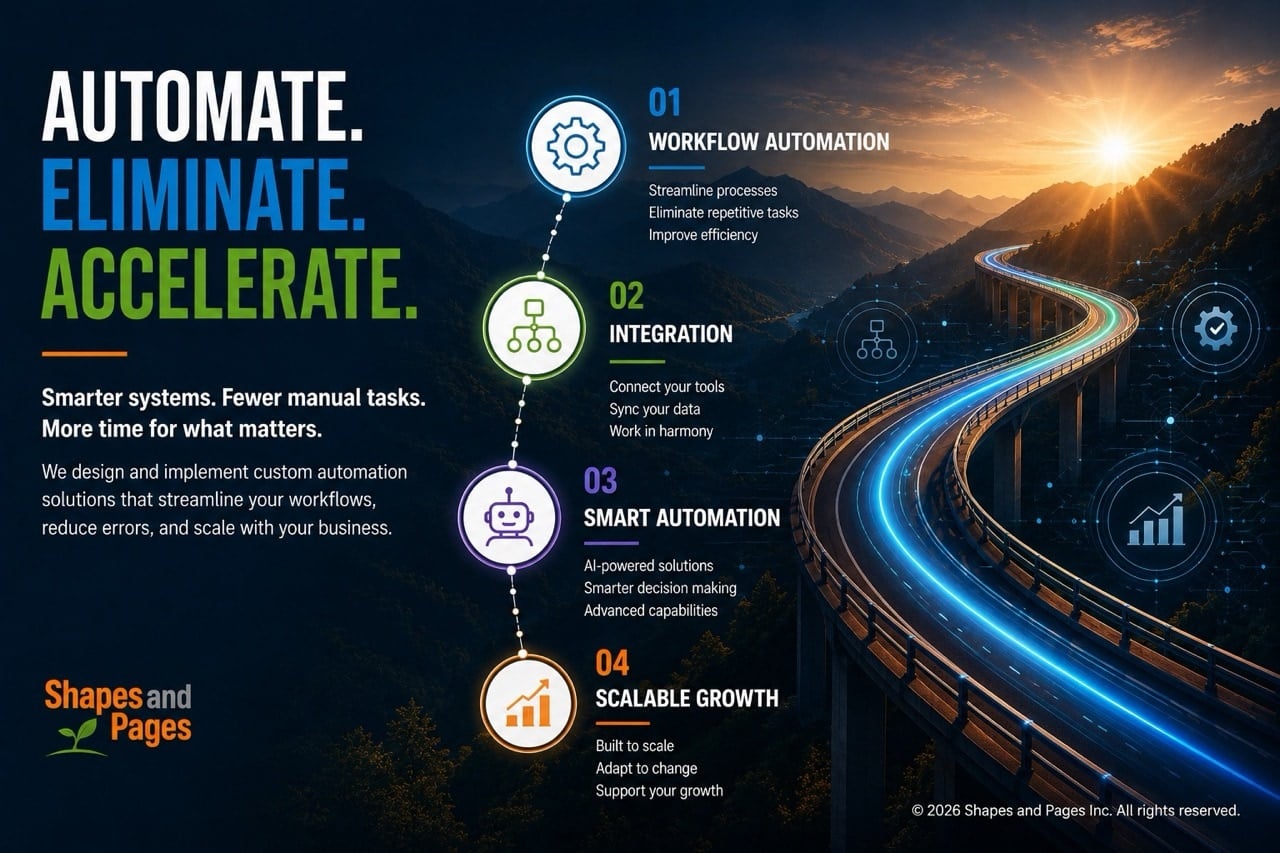
Businesses often lack the systems needed to capture, nurture, and retain those opportunities effectively. These systems can also be prohibitively expensive, often charging by the number of contact emails you have. We fix that with CRM Market Pro.
Marketing Automation Services That Turn Leads Into Customers
Attracting a qualified prospect is only valuable when the business can respond, follow up, and guide that person toward the next decision. Shapes and Pages builds small business marketing automation systems that connect website inquiries, CRM records, email, text messaging, appointments, reviews, and customer communication. The objective is not to send more automated messages; it is to make important customer interactions timely, useful, measurable, and less dependent on someone remembering every step.
Our marketing automation services can support a new connected system, improve an existing CRM, or solve one costly follow-up problem first. We begin with the business process and the customer experience, then determine which platform, workflow, message, and measurement approach fit the need. That keeps the engagement focused on better lead handling and customer relationships instead of an unnecessary collection of software features.
Choose the Right Automation Engagement for Your Business
Business owners searching for a marketing automation agency are often facing different problems. One company may need a complete CRM and lead-management system, while another already has capable software but cannot trust its data, workflows, or follow-up. The first decision should therefore be the type of engagement that addresses the current constraint without creating more complexity than the team can maintain.
New CRM and Marketing Automation System
A new implementation may be appropriate when leads are scattered across inboxes, spreadsheets, phones, and disconnected applications. Shapes and Pages can map the lead journey, configure CRM Market Pro, connect website forms and calendars, establish pipelines, and build the initial email or SMS workflows required to manage opportunities consistently. The scope should identify what must be ready for launch, what can be introduced later, and who will own each part of the process.
Focused Lead Follow-Up Automation
Some businesses do not need a full transformation to create meaningful value. A focused project may address form-response delays, missed calls, unreturned estimates, appointment reminders, or another specific point where opportunities are being lost. Starting with one observable workflow allows the business to test the process, confirm team adoption, and decide whether a broader system deserves the next investment.
CRM Cleanup and Automation Improvement
An existing CRM can become difficult to use when fields, tags, pipelines, lists, and automations have accumulated without a shared plan. A CRM automation assessment can identify duplicate processes, unreliable triggers, outdated messages, poor data practices, unclear ownership, and gaps between the website and the sales process. Shapes and Pages can then recommend what to preserve, simplify, rebuild, or retire before additional automation is added.
Ongoing Automation Support and Optimization
Customer behavior, services, team responsibilities, and marketing campaigns change after the initial launch. Ongoing support can include workflow monitoring, message updates, new campaigns, data review, testing, reporting, and prioritized improvements. The work should be driven by current business impact and system evidence rather than a standing checklist of low-value activity.
Start With the Customer Journey, Not the Software
Automation should reflect how the business actually earns and serves customers. Shapes and Pages first identifies the services the company wants to grow, the sources of its best opportunities, the questions prospects ask before buying, and the points where a person or system must take responsibility. Only then should the project define CRM stages, triggers, messages, integrations, and reports.
This approach applies the Shapes and Pages SEO Methodology beyond search. The methodology asks what improvement would make the website and connected growth system a better answer for the customers the business wants to attract. Automation becomes the differentiator after the right business problem has been selected, not a substitute for understanding that problem.
Business Priorities
The assessment begins with the offers, customer groups, locations, and revenue opportunities that matter most. It also considers the practical cost of delayed follow-up, missed calls, unreturned estimates, no-shows, inactive customers, and manual administrative work. These priorities determine which workflow should be improved first and what a useful result would look like.
Customer Questions and Expectations
Prospects want to know that their request was received, what happens next, how quickly someone will respond, and what information they should prepare. Customers may need reminders, instructions, status updates, educational resources, or a clear way to ask for help. Effective automation answers those needs without pretending that every situation can or should be handled without a person.
Process, Data, and Technical Structure
The system must define where a lead originates, which information is collected, where the record is stored, how it is categorized, who owns the next action, and how completion is measured. Website forms, calendars, inboxes, phone systems, CRM fields, permissions, integrations, consent records, and reporting must work as one understandable process. Technical configuration matters, but it should serve the customer journey and the team responsible for managing it.
Marketing Automation Services for Small Businesses
Shapes and Pages combines strategy, CRM implementation services, customer communication, website integration, and ongoing improvement. The exact scope depends on the current tools, lead volume, sales cycle, internal capacity, and risk of changing an established process. The following service areas can be implemented together or prioritized in phases.
Website Lead Capture and CRM Integration
Website forms, landing pages, calls, advertising leads, newsletter signups, and appointment requests should create usable records rather than isolated notifications. Website CRM integration can route each inquiry into the appropriate pipeline, identify the source and service interest, notify the right person, and preserve the information required for follow-up. This gives the team a shared view of new opportunities and reduces manual copying between systems.
The form itself should collect enough information to guide the next action without creating unnecessary friction for the prospect. Shapes and Pages can review field requirements, confirmation messages, notifications, tracking, error handling, and ownership as part of the workflow. A lead-capture system is complete only when the business can see that the inquiry arrived and knows who is responsible for it.
Automated Lead Response and Follow-Up
Lead follow-up automation can acknowledge an inquiry immediately, explain the next step, alert the team, and schedule a useful follow-up when no response has been recorded. Missed-call text back, estimate follow-up, contact-form responses, and internal reminders can reduce the number of opportunities that disappear between initial interest and a real conversation. The automation should support the salesperson or service team, not create competing conversations with the prospect.
Every sequence needs clear stopping conditions, ownership rules, and escalation paths. When a prospect replies, books, declines, or requires personal attention, the system should update the record and adjust what happens next. That discipline prevents repeated messages and makes the CRM a more reliable account of the relationship.
Email and SMS Marketing Automation
Email marketing automation services can support lead nurturing, educational sequences, customer onboarding, announcements, newsletters, and re-engagement. SMS marketing automation can be useful for time-sensitive confirmations, reminders, missed-call responses, or short follow-up messages when consent and context make text appropriate. Channel selection should be based on the customer’s expectation and the job the message must perform, not on the novelty of the tool.
Automated communication still needs clear, human writing. Messages should answer a real question, make the next step easy, and sound consistent with the business rather than like a generic template. Frequency, segmentation, consent, opt-out handling, and suppression rules should be considered before a sequence is activated.
Automated Lead Nurturing and Sales Pipeline Support
Not every qualified prospect is ready to buy during the first conversation. Automated lead nurturing can provide relevant explanations, case examples, reminders, or decision resources over an appropriate period while the opportunity remains visible to the team. CRM stages, tasks, and follow-up rules help sales activity reflect the actual state of the decision instead of relying on memory or scattered notes.
The strongest nurturing sequences are connected to the questions that influence a purchase. A service inquiry may need information about fit, process, timing, investment, alternatives, or risk before another sales contact is useful. Shapes and Pages can align those messages with the commercial website pages and supporting content that already answer those questions.
Appointment, Reminder, and No-Show Workflows
Scheduling automation can coordinate booking confirmations, intake requests, reminders, rescheduling, internal preparation, and post-appointment follow-up. The system can reduce repetitive administration while giving the customer a clearer experience before and after the meeting. It can also distinguish between an appointment that needs a simple reminder and one that requires documents, qualification, or a personal confirmation.
Automation should not hide scheduling problems behind more messages. The assessment should consider calendar ownership, availability rules, time zones, cancellation policies, duplicate bookings, and what happens when a person replies outside the expected path. A reliable appointment workflow includes exception handling as well as the ideal sequence.
Review Requests and Reputation Workflows
Review request automation can prompt an appropriate customer for feedback after a completed service, purchase, appointment, or other defined success point. Timing, wording, channel, and eligibility rules should reflect the real customer experience and the policies of the review platform. The workflow should make it easy to respond while preserving an honest and compliant review process.
Reviews also create information the business can learn from. Positive feedback may reveal language customers use to describe value, while concerns may identify a service or communication issue that deserves attention. Shapes and Pages can connect review activity to local visibility and customer-experience priorities without treating automation as a method for manufacturing reputation.
Customer Re-Engagement and Retention Campaigns
Existing customers may need maintenance reminders, seasonal information, renewal notices, replenishment prompts, relevant offers, or a useful reason to reconnect. Customer re-engagement campaigns can segment inactive contacts and deliver communication that reflects what they previously purchased or requested. This can help the business create repeat opportunities without sending the same promotion to every person in the database.
Retention automation works best when it supports genuine continued value. The process should define which customers are eligible, when a message becomes relevant, and what response should move the record into a new workflow. That keeps retention activity connected to the customer relationship rather than turning the CRM into a broadcast list.
Reporting, Testing, and Workflow Optimization
Automation reporting should show whether the system is operating as designed and whether people are moving toward the intended next step. Useful measures may include response time, contact rate, appointments, show rate, pipeline movement, follow-up completion, email or SMS response, review requests completed, reactivated customers, and administrative time saved. Open and click metrics can provide context, but they should not be mistaken for business outcomes.
Testing should cover both the ideal path and the exceptions. Forms, integrations, duplicate records, permissions, message timing, replies, opt-outs, routing, alerts, and failed actions all require attention. Ongoing optimization uses that evidence to select the next highest-impact improvement rather than adding another workflow simply because the platform can support it.
CRM Market Pro Connects the Critical Parts of Follow-Up
CRM Market Pro is the Shapes and Pages platform for bringing lead capture, customer records, conversations, email, text messaging, calendars, pipelines, reviews, and retention activity into one coordinated environment. It is not positioned as an AI tool that replaces the people responsible for sales or service. Its purpose is to give those people a dependable system for responding, following up, and seeing what needs attention.
A consolidated platform can reduce the gaps created by disconnected forms, spreadsheets, inboxes, calendars, and marketing tools. Consolidation is valuable only when it simplifies the operation, however, so the Automation Assessment should consider the systems already in use, required integrations, data migration, recurring costs, team habits, and any capability that should remain elsewhere. The recommendation may be a CRM Market Pro implementation, a phased transition, or a focused improvement that protects a useful existing process.
A Practical System, Configured Around the Business
Configuration can include pipelines, custom fields, tags, forms, calendars, workflows, templates, permissions, and dashboards that reflect how the company manages customers. The implementation should document what each automation does, what triggers it, who owns the next step, and how the team can recognize a problem. The system becomes useful when employees can trust it during ordinary work, not merely when it performs correctly in a demonstration.
How the Automation Implementation Process Works
A buyer should understand what happens between the first conversation and a working system. Shapes and Pages uses a staged process so strategy, configuration, communication, testing, and adoption remain connected. The final scope and sequence depend on whether the engagement is a new implementation, a focused workflow, or an improvement to an existing system.
1. Automation Assessment
We review the business objective, customer journey, lead sources, current tools, CRM data, team responsibilities, communication requirements, and known breakdowns. The assessment identifies where revenue opportunities or customer experiences are being affected and which process should be addressed first. It also surfaces dependencies such as platform access, data quality, consent, integrations, and staff availability.
2. Workflow Blueprint
The workflow is mapped before it is built. The blueprint defines triggers, required data, routing, messages, delays, decision branches, stopping conditions, ownership, exceptions, and success measures. This creates a shared understanding of the process and gives the business a chance to correct assumptions before configuration begins.
3. CRM Configuration and Integration
Shapes and Pages configures the approved fields, pipelines, forms, calendars, templates, workflows, notifications, and integrations. Existing data may require cleanup, mapping, or staged migration before the new process can be trusted. Access, permissions, account ownership, and recurring dependencies should be documented as part of the implementation.
4. Testing, Training, and Launch
The system is tested with realistic scenarios, including replies, errors, duplicate contacts, missed steps, opt-outs, and handoffs to a person. The people who will use the system need to understand what automation handles, what remains their responsibility, and how to identify an exception. Launch may be phased when a limited rollout reduces operational risk or provides better evidence.
5. Measurement and Prioritized Improvement
Early monitoring confirms that the workflow is running and that the data reflects what happened. Performance evidence, staff feedback, customer behavior, and new business priorities are then used to reprioritize the next improvement. This keeps the system current and follows the Shapes and Pages discipline of investing the available budget in the most valuable opportunity now.
Is Marketing Automation the Right Fit?
Marketing automation is a strong fit when the business already receives inquiries or serves an established customer base but struggles to manage consistent communication. It is also useful when lead sources are increasing, several people need shared visibility, routine tasks are consuming valuable time, or the team cannot reliably see what should happen next. A focused workflow can be appropriate for a small company, while a larger system may support multiple services, locations, or sales paths.
Automation is not the first answer when the business has no defined offer, no meaningful source of leads, or an unstable process that changes every time it is performed. It also cannot repair unclear sales responsibilities, poor service, or messages that do not help the customer decide. In those cases, the responsible recommendation may be to clarify the process, improve the website, or fix lead generation before building a broader automation system.
Good Indicators That an Assessment Is Worthwhile
- Website inquiries receive inconsistent or delayed responses.
- Missed calls, estimates, proposals, or appointments are not followed up reliably.
- Customer records are divided among spreadsheets, inboxes, phones, and unrelated tools.
- The business pays for traffic but cannot see what happens to each lead afterward.
- Employees repeat the same reminders, updates, data entry, or reporting tasks.
- Customers rarely receive useful communication after the first sale.
- The existing CRM is underused, difficult to trust, or filled with outdated workflows.
Automation Within the Shapes and Pages Growth Framework
The Shapes and Pages Growth Framework describes the connected customer journey: Attract, Engage, Delight, and Retain. SEO, paid advertising, referrals, and other channels help Attract qualified visitors. Website content, forms, lead response, and nurturing help Engage those visitors while their interest is active.
Confirmations, onboarding, reminders, service communication, and well-timed review requests can support Delight. Newsletters, renewal prompts, re-engagement, and continued customer value can support Retain. The Growth Framework explains where automation contributes to the journey, while the SEO Methodology determines which improvement should receive the next investment.
Connect Visibility to the Customer Relationship
Automation helps Shapes and Pages connect traffic acquisition to what happens after a visit. A source, campaign, landing page, service interest, and customer outcome can be carried into the CRM when the technical and data structure supports it. That connection gives the business a better basis for deciding whether the next priority belongs in SEO, paid ads, the website, follow-up, retention, or another part of the growth system.
Make SEO, Paid Ads, Websites, and Automation Work Together
Search visibility and paid campaigns create opportunity, but neither channel can control what happens after a person submits a form or calls the business. The website must explain the offer and make the next step clear, while the automation system must acknowledge the inquiry, preserve its source, notify the right person, and support continued communication. Treating those components as one system makes it easier to identify whether a performance problem begins with traffic, conversion, follow-up, or sales execution.
This integrated approach is a practical differentiator for Shapes and Pages. We can examine the commercial page that generated the inquiry, the form or call path, the CRM record, the follow-up sequence, and the customer outcome as related evidence. The tools may change, but the decision remains the same: choose the next improvement according to its likely business impact.
Measure What the Automation Was Built to Improve
The measurement plan should begin with the original reason for the project. A lead-response workflow may be evaluated through response time, contact rate, appointments, qualified conversations, and pipeline movement. A retention workflow may require different evidence, such as renewed customers, repeat purchases, reactivated accounts, completed review requests, or reduced administrative effort.
Shapes and Pages does not assume that an email open, an automated message, or a new contact automatically represents business growth. Reporting should explain what changed, what the available evidence can support, and where attribution remains uncertain. Those findings are then used to decide whether the next budget should improve the workflow, the message, the source traffic, the website, or the human process around the system.
Why Businesses Choose Shapes and Pages for Marketing Automation
Shapes and Pages is an SEO Focused Growth Agency, so automation is planned in the context of visibility, website experience, conversion, customer communication, and retention. That broader perspective helps prevent the CRM, forms, campaigns, and reports from becoming isolated deliverables. The engagement stays connected to the services the business wants to grow and the questions its customers need answered.
Our role is consultative and implementation focused. We explain what the system will do, what it will not do, which responsibilities remain with the client, how data and accounts are handled, and what evidence will be used after launch. A buyer should be able to understand the proposed process and its dependencies before committing to a larger automation investment.
Strategy Before Software
We identify the operational and customer problem before recommending a workflow or platform configuration. This protects the budget from being spent on impressive features that do not solve the current constraint. It also creates a clearer basis for comparing CRM Market Pro with the tools the business already uses.
Connected Website and Growth Expertise
Automation decisions frequently depend on forms, landing pages, analytics, search traffic, paid campaigns, calls, content, and conversion paths. Shapes and Pages can evaluate those connections as parts of the same customer journey. That reduces the risk of building a technically functional automation around a weak or confusing entry point.
Practical Ownership and Support
The scope should identify account ownership, access, data responsibilities, platform costs, third-party dependencies, documentation, and ongoing support. Team members should know how to use the system and how to request changes as the business evolves. The goal is a manageable operating system with visible dependencies, not a collection of hidden automations that only the original builder understands.
Marketing Automation Services FAQs
What does a marketing automation agency do?
A marketing automation agency maps customer and internal processes, configures CRM and communication tools, connects data sources, builds workflows, tests the system, and helps the team use it. The work may include lead capture, routing, email and SMS sequences, appointments, reviews, re-engagement, reporting, and ongoing optimization. The right agency should explain how those activities support a defined business outcome rather than selling automation as an outcome by itself.
How much do marketing automation services cost?
Cost depends on the number of workflows, platforms, users, integrations, messages, data requirements, migration needs, testing, training, and ongoing support.
A focused lead follow-up automation is a different engagement from a complete CRM implementation with multiple pipelines and customer journeys.
The Automation Assessment is used to define what must be included now, what can be phased, and which software or third-party costs remain separate.
How long does a CRM and marketing automation implementation take?
We like to build automation in incremental steps that will allow rapid deployment rather than trying to to build a comprehensive solution all at once.
If we begin with lead capture on your website and incorporate automation, this can be running in less than a week. A contact form on your website that also captures lead information in a few days. Importing leada contact information from Mailchimp or one of the other email tools ... less than a day.
Timing for a full and comprehensive implementation depends on process complexity, access, data quality, integrations, message approvals, testing, and the availability of the people who understand the current operation.
Shapes and Pages defines stages, responsibilities, dependencies, and launch criteria before implementation so the timeline reflects the actual work.
Do we need to replace our current CRM or marketing tools?
Not necessarily. The assessment should determine whether the current tools can support the required process, whether an integration or cleanup would solve the problem, and whether consolidation into CRM Market Pro would create enough value to justify the change. Preserving a useful existing system may be preferable when switching costs, data risk, team adoption, or a specialized capability outweigh the benefit of replacement.
What is included in CRM implementation services?
Breaking down an installation into website use cases, and implementing them one at a time is often the best way to deliver value quickly.
CRM implementation services may include process discovery, data and field planning, pipeline configuration, user roles, forms, calendars, automation rules, templates, integrations, migration, dashboards, testing, training, and documentation.
The exact scope should be tied to the approved customer journey and internal responsibilities. Shapes and Pages separates launch requirements from later improvements so the implementation remains usable and financially practical.
Can automation respond to website leads and missed calls?
Yes, CRM Market Procan acknowledge a website inquiry, create or update the CRM record, notify the team, and trigger the appropriate next step.
Missed-call text back can also be configured including consent requirements, message context, and staff process to support it.
Workflows require clear staff ownership so a fast automated response leads to a timely human conversation when one is needed.
Can marketing automation help nurture leads that are not ready to buy?
Yes, automated lead nurturing can deliver relevant information and appropriate follow-up over a longer decision period. The sequence should be based on the prospect’s interest, questions, behavior, and stage rather than sending the same messages to every contact. It should also stop or change when the person replies, books, opts out, becomes a customer, or no longer fits the intended path.
Can the system automate review requests and customer retention?
Yes, review requests can be triggered after a defined service milestone, while retention workflows can support reminders, newsletters, renewals, repeat purchases, and re-engagement. The rules should reflect the customer experience and the policies of the communication and review platforms. Automation should make useful communication consistent without manipulating reviews or overwhelming customers.
How do you keep automated email and text messages from sounding robotic?
The message begins with the customer’s situation and the purpose of the interaction, not with a software template or AI. No worries about hallucination here.
Shapes and Pages writes concise, useful communication that explains what happened, what the person can expect, and what action is available. Segmentation, timing, reply handling, and human handoffs matter as much as tone because irrelevant communication feels automated even when the wording sounds friendly.
What information is needed before an automation can be built?
Companies without extensive and sophisticated processes will have a much easier time with Automation implementation.
In a complex situation, an assessment is required where the The business should be prepared to explain its offers, lead sources, customer journey, sales or service stages, existing tools, team responsibilities, common exceptions, and desired outcome.
The assessment identifies missing decisions and data before they become expensive implementation problems.
What happens after the automation launches?
After launch, we monitor the system for any failed actions, incorrect routing, duplicate records, unexpected replies, opt-outs, data problems, and staff adoption. Performance measures and team feedback show whether the workflow is solving the intended problem and where it should change. Ongoing support can then prioritize maintenance, message updates, new workflows, integrations, or broader growth opportunities.
How will we know whether marketing automation is working?
Success measures are selected according to the job the automation was built to perform. They may include faster response, more completed follow-up, qualified conversations, appointments, show rate, pipeline movement, reviews, returning customers, or time saved. Shapes and Pages uses those measures to identify the next improvement and avoids treating message volume or platform activity as sufficient proof of business value.
Start With an Automation Assessment
We're an SEO Focused Growth Agency
Let's Talk
If you are comparing marketing automation services, a CRM implementation consultant, or a small business automation agency, begin with the process that is costing the business the most opportunity or time. Shapes and Pages will review lead sources, the website, customer questions, current tools, CRM data, follow-up responsibilities, communication needs, and measurement. The assessment will help determine whether the right next step is a focused workflow, a CRM cleanup, a CRM Market Pro implementation, or another growth priority.
You will receive a practical explanation of what should be addressed first, what can wait, and which client decisions or dependencies affect the work. The recommended scope will connect the automation to the website, customer journey, team process, and business outcome it is expected to support. This provides a clearer basis for investment before implementation begins.