
Business Websites Built to Generate Leads
Conversion-Focused Websites Built for Growth
Business Websites Built to Generate Qualified Leads
Shapes and Pages designs and rebuilds business websites around the services you most want to sell and the questions customers ask before they contact you. Our conversion-focused web design connects clear messaging, SEO-aligned structure, responsive development, analytics, and practical integrations so the website can attract qualified visitors and turn more of them into calls, forms, bookings, and sales opportunities. Whether you need a new website, a redesign, focused improvements, or ongoing website support, the engagement begins with the business problem—not a design template.
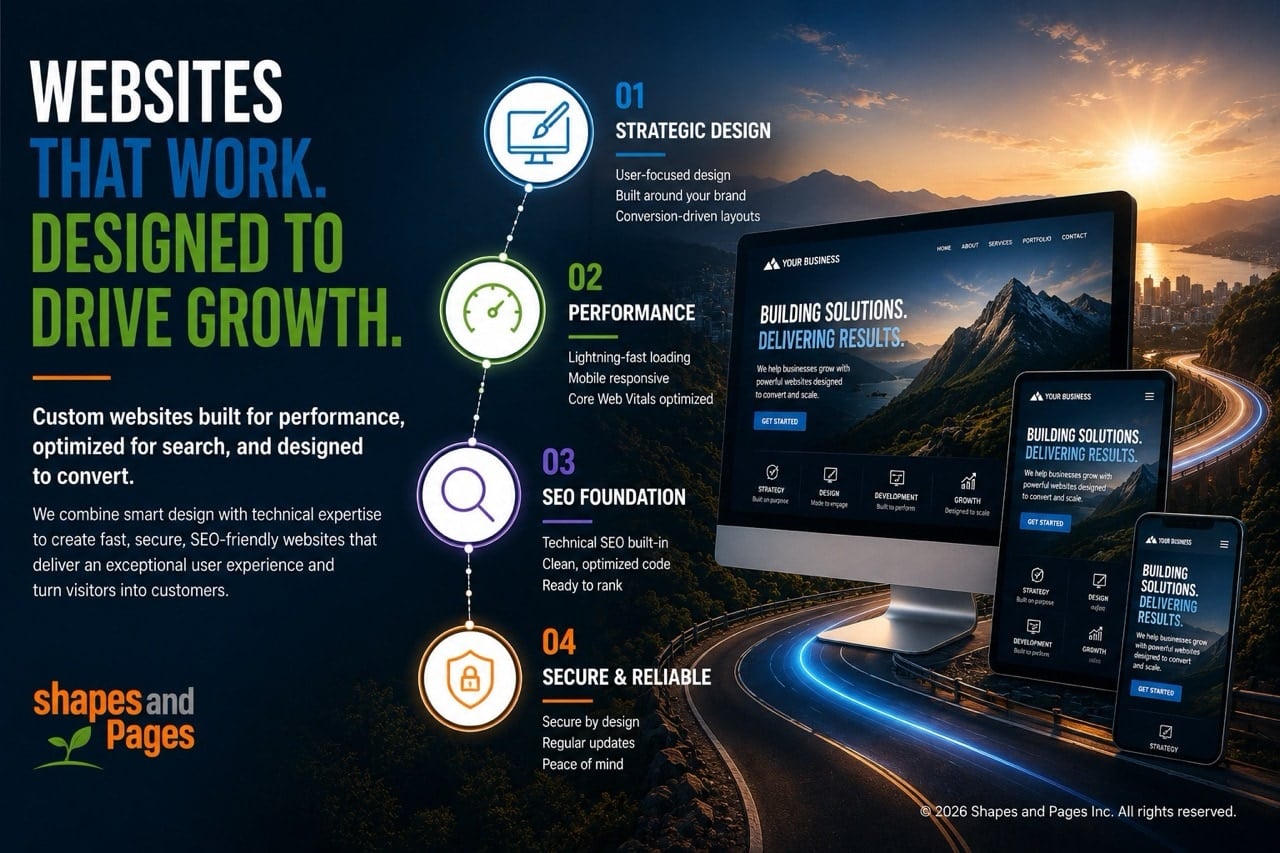
A Conversion-Focused website aligned to your SEO strategy is critical for both lead capture and Search Ranking.
Choose the Website Engagement That Fits the Business
The right website engagement depends on what is already working, what is limiting growth, and what the business needs the website to accomplish next. A new company may need a complete foundation. An established business may need professional website redesign services, while another may need targeted improvements, integrations, or ongoing website management rather than a full rebuild.
Shapes and Pages reviews the priority services, intended customers, customer questions, current content, technical condition, search visibility, conversion paths, integrations, internal capacity, and budget before recommending a scope. That assessment helps distinguish an essential requirement from a useful later enhancement. The recommendation may be a new website, a redesign, a focused project, or continuing support and optimization.
At Shapes and Pages, we build websites as part of a growth strategy — combining design, SEO, user experience, and automation into one system from the start.
Businesses investing in Google Ads management often see the greatest return when those campaigns drive traffic to conversion-focused landing pages.
New Business Website Design
A new website should establish the structure, content, technology, and measurement required to support the business from the beginning. Shapes and Pages defines who the site must serve, what those visitors need to understand, which products or services deserve priority, and what action represents a valuable conversion. Those decisions guide the sitemap, page requirements, messaging, responsive design, development, analytics, and launch plan.
Website Redesign and Rebuild Services
A redesign is appropriate when the current site no longer reflects the business, creates technical or administrative friction, underperforms in search, or fails to support customer decisions. Shapes and Pages assesses which pages, rankings, content, assets, integrations, and customer journeys should be preserved, improved, consolidated, redirected, or retired. A complete rebuild is recommended only when the platform or accumulated limitations make focused improvements an inefficient investment.
Focused Website Improvements
Not every website problem requires a full redesign. A focused project may improve a high-value service page, navigation, calls to action, mobile usability, performance, forms, analytics, search structure, or a specific integration. This can create a controlled starting point for a small or midsize business that needs measurable progress without replacing the entire site.
Website Maintenance, Support, and Optimization
Ongoing website support services help the site remain useful as the business, customers, search environment, and technology change. Work may include content updates, technical troubleshooting, new pages, analytics, conversion improvements, integration changes, performance, or coordination with hosting and platform providers. Priorities are chosen according to business impact and estimated effort rather than a generic maintenance checklist.
Structure the Website Around Customer Decisions Before Design Begins
A website can look polished and still underperform when its structure does not reflect what the business sells or what customers need to know before buying. Shapes and Pages begins with business priorities, customer questions, and the technical and search structure required to connect those two. Those decisions determine the sitemap, page hierarchy, messaging priorities, conversion paths, and project scope before visual design begins.
This approach also prevents SEO, content, analytics, and integrations from becoming expensive repairs after launch. The website is planned as a business system that must attract the right people, answer their questions, support a confident next step, and remain practical to manage. Design becomes the visual and experiential expression of that strategy rather than a substitute for it.
Business Priorities
The website should make the services, products, and markets most important to the business easy to find and understand. Shapes and Pages identifies the offers that create the greatest value, the audiences the business is equipped to serve, and the actions that represent meaningful progress. Those priorities guide which pages are required, how navigation is organized, where proof is needed, and which conversion paths deserve the most attention.
Customer Questions
Prospective customers need answers about cost, process, timing, suitability, risk, alternatives, capabilities, and expected outcomes before they contact a business. Those questions shape the content and hierarchy of each important page. A useful website reduces uncertainty, establishes credibility, and helps the visitor understand whether the company is a good fit without forcing them to search across disconnected pages.
Technical and Search Structure
The site architecture should help people and search engines understand the relationship among services, locations, industries, resources, and supporting content. Crawlability, indexation, redirects, internal linking, metadata, structured data, mobile experience, performance, and measurement are considered while the site is being planned. This creates a stronger technical foundation for future SEO, content, paid advertising, analytics, and automation work.
Learn how the Shapes and Pages SEO Methodology begins with the business, customer questions, technical roadblocks, high-value pages, measurement, and the next improvement.
What Your Website Needs
A complete business website may require strategy, content, custom web design services, responsive development, search-friendly architecture, analytics, forms, integrations, and post-launch support. Shapes and Pages defines the scope according to the business problem instead of assuming every project needs the same pages or features. Each component should contribute to clarity, usability, qualified discovery, conversion, or reliable operation.
The website must also be practical after launch. Content should be maintainable, business-critical accounts should remain under appropriate client control, and integrations should support real workflows rather than add unnecessary complexity. The following four service groups organize the work without treating strategy, design, SEO, and technology as isolated tasks.
Strategy and Content
Strategy defines what the website must accomplish before design and development begin. Shapes and Pages identifies the priority services, intended customers, key questions, competitive context, conversion goals, content requirements, and information hierarchy. This work creates the sitemap and page plan that keep the project tied to business value instead of allowing preferences or a template to determine the structure.
Content then turns that strategy into useful answers. Shapes and Pages can improve existing copy, create page outlines, develop new service or location pages, and connect supporting resources to the commercial pages they strengthen. Messaging should explain the offer clearly, establish credibility, address important objections, and guide the visitor toward the next appropriate action.
Design and Development
Design gives the strategy a clear, credible, and usable visual form. Page layouts, navigation, typography, imagery, calls to action, forms, and reusable components should help visitors scan, understand, and act without unnecessary friction. Conversion-focused web design does not mean filling every screen with buttons; it means making the next decision obvious and appropriate to the visitor’s stage.
Development turns the approved design into a responsive, reliable website that works across phones, tablets, and desktop devices. The scope may include content-management configuration, reusable page patterns, forms, accessibility considerations, cross-browser testing, performance work, and launch controls. The technical implementation should support future content and marketing needs without making routine updates unnecessarily difficult.
SEO and Performance
SEO website design considers customer searches and technical requirements while the site architecture is still being created. Shapes and Pages may map important topics to the right service, location, or industry pages; plan internal links; preserve valuable URLs; prepare redirects; and implement metadata, structured data, sitemaps, indexing controls, and analytics. Search readiness is treated as a launch requirement rather than an add-on after the site is published.
Performance affects both user experience and the website’s ability to support search and conversion. Responsive images, efficient page components, mobile usability, stable layouts, hosting considerations, and Core Web Vitals may all influence the plan. The objective is not a perfect diagnostic score at any cost, but a fast and dependable experience that removes technical friction from important customer journeys.
Integrations and Support
Modern business websites often need to connect forms, CRM systems, booking tools, email platforms, analytics, call tracking, payments, inventory, or automation. Shapes and Pages defines the workflow before development so data fields, notifications, ownership, privacy needs, error handling, and follow-up expectations are understood. An integration should reduce manual work or improve the customer experience rather than add a tool with no clear operational purpose.
Support after launch can include updates, troubleshooting, content changes, new pages, platform coordination, analytics, optimization, and integration improvements. The level of support should reflect the internal capacity of the business and the complexity of the website. A clear ownership and maintenance plan helps prevent the site from becoming outdated, insecure, inconsistent, or difficult to improve.
A Website Design and Redesign Process With Clear Decisions
The project process should make responsibilities, approvals, and dependencies visible before they create delays. Shapes and Pages organizes the work into strategy, structure and content, design and development, and launch and improvement. Each stage produces a decision that the next stage can rely on, which reduces rework and prevents late discoveries about content, SEO, integrations, or technical limitations.
The specific timing depends on page count, content readiness, platform, integrations, migration risk, and the availability of client stakeholders. A focused small business website can move faster than a large redesign involving many service pages, locations, custom workflows, or approval teams. The schedule should reflect the real scope rather than promise a universal launch date.
Discovery and Strategy
Discovery clarifies the business objective, intended audience, priority offers, current problems, competitive context, required features, internal responsibilities, and measures of success. Existing analytics, search performance, pages, content, integrations, and technology are reviewed when available. The result is an agreed project direction and a practical definition of what the website must accomplish.
Structure and Messaging
The structure stage turns the strategy into a sitemap, page hierarchy, navigation, content requirements, and conversion paths. Shapes and Pages identifies which questions belong on each page and how important pages should connect through internal links. Wireframes or content-first layouts can then test whether the information sequence works before visual styling makes changes more expensive.
Design and Development
Design establishes the visual system and page patterns needed to communicate the brand and support customer decisions. Development implements those patterns in the selected platform, connects approved content and features, and prepares the site for responsive use. Client reviews should focus on defined decisions at each stage so feedback can be incorporated without repeatedly reopening previously approved work.
Launch and Improvement
Launch preparation includes content review, forms, integrations, analytics, redirects, metadata, search controls, mobile and browser testing, performance, backups, access, and ownership checks. After publication, essential functionality and early data should be monitored so issues can be corrected quickly. The website then moves from project delivery into measurement and ongoing improvement.
Website Design for Small Businesses, B2B Companies, and Manufacturers
Different business models require different website answers. A local service business may depend on geographic pages, reviews, prominent calls, scheduling, and rapid follow-up. A manufacturer may need detailed capabilities, applications, specifications, certifications, markets served, and a path for technical or distributor inquiries, while a B2B organization must account for longer decision cycles, multiple stakeholders, proof requirements, and the relationship between marketing content and sales conversations.
Shapes and Pages builds the architecture around those differences rather than forcing every company into the same template. Small and midsize businesses can begin with the service lines and customer journeys that matter most, then expand as demand, budget, or internal capacity grows. Flexible page patterns, useful content structures, analytics, and integrations allow the site to support new services, locations, markets, and campaigns without requiring another complete redesign.
Determine Fit Before Committing to a Website Project
A Website Assessment should evaluate whether the current site can be improved or whether a redesign creates a better long-term investment. Platform limitations, technical debt, search visibility, valuable content, migration risk, integrations, administrative burden, and the cost of repair all affect that decision. In some cases, the responsible recommendation may be focused improvements or ongoing support rather than a new website.
Fit also depends on the working relationship. The client should understand who supplies subject-matter expertise, content approvals, brand materials, platform access, legal or privacy requirements, and decisions about integrations. Shapes and Pages should explain what it will manage, what requires collaboration, what the budget covers, and what evidence will be used to evaluate the result.
The Website Within the Shapes and Pages Growth Framework
A search-ready website helps Attract qualified visitors through organic search, paid advertising, referrals, local visibility, and other channels. Clear content, credible design, intuitive navigation, and useful conversion paths help Engage those visitors. Forms, booking tools, CRM connections, automation, and helpful post-sale resources can support Delight, while continued value, communication, and customer systems contribute to Retain.
The Growth Framework explains that connected customer journey; the SEO Methodology provides the decision discipline behind the work. Business priorities, customer questions, technical roadblocks, page performance, conversion evidence, and operational needs are considered together to determine what should improve next. The website becomes the shared platform where marketing, customer experience, and business systems meet, but each component is measured according to the job it actually performs.
Build a Website That Can Improve Instead of Starting Over
A website should be able to accommodate new services, locations, customer questions, campaigns, integrations, and evidence without requiring another redesign for every change. Reusable page patterns, clear content relationships, appropriate technology, and maintainable administration help the business adapt as priorities change. That flexibility is valuable only when it preserves clarity and quality rather than accumulating uncontrolled additions.
Shapes and Pages uses performance data and business priorities to identify the next useful improvement after launch. The next step may be a new service page, stronger internal links, a conversion change, technical correction, CRM workflow, automation, or supporting content. This is where the methodology becomes the differentiator: the tools may change, but the next investment is chosen according to business impact.
Website Optimization, Maintenance, and Support After Launch
Launch is the beginning of the website’s useful life, not the end of the work. Search behavior, competitors, technology, customer questions, and business priorities continue to change, which means even a well-built site benefits from measurement and improvement. Website optimization services use actual performance and operational evidence to identify which pages, journeys, or systems deserve attention.
Shapes and Pages can provide website maintenance services, website support services, or focused optimization projects according to the level of help the business needs. The priority list may include content changes, new pages, technical issues, platform updates, performance, analytics, forms, broken functionality, conversion improvements, or integrations. Work is ordered by likely business impact and effort so the support budget improves the website rather than funding activity for its own sake.
Measure What the Website Was Built to Accomplish
Success measures should reflect the original business objective. They may include qualified traffic, visibility for priority services, calls, forms, bookings, sales inquiries, conversion rate, engagement with high-value pages, technical health, uptime, and administrative time saved through integrations. Design quality remains important because it supports credibility and use, but visual preference alone is not the final measure of value.
Reporting should explain what changed, why it may have changed, what the evidence can and cannot prove, and what should happen next. Shapes and Pages uses measurement to prioritize future work rather than treating launch or a monthly report as the endpoint. This creates a continuing improvement system in which the website becomes more useful to customers and the business over time.
Why Businesses Choose Shapes and Pages
Shapes and Pages combines website strategy, design, development, SEO, analytics, and automation through one business-first decision process. That perspective helps prevent the sitemap, content, design, search structure, and integrations from being planned as unrelated deliverables. The project remains connected to the services the business wants to grow and the customer questions the website must answer.
Shapes and Pages has helped businesses build an effective presence on the web since 2006. The work is managed directly rather than separated from the people responsible for strategy and client communication. Buyers should understand who is making recommendations, who is implementing the work, how decisions are communicated, and where the approved budget is being invested.
Ownership, Access, and Practical Independence
Business-critical assets should remain under appropriate client control. The project scope should identify ownership and access for the domain, DNS, hosting, website platform, analytics, tag management, forms, CRM connections, content, creative assets, plugins, licenses, and third-party services. Any recurring cost, proprietary dependency, or data-retention limitation should be explained before launch.
Practical independence also means the business understands how routine changes are made and what requires specialized support. Training, documentation, or an ongoing support relationship may be appropriate depending on the platform and internal team. The objective is not to eliminate every dependency, but to make those dependencies visible and intentional.
Evidence That Connects Website Work to Business Outcomes
Strong website evidence is more than a before-and-after screenshot. A useful case example identifies the baseline, work completed, measurement period, source data, and result so a prospective client can understand what changed. Qualified leads, service-page visibility, conversion rate, sales inquiries, administrative efficiency, and technical health provide stronger context than an isolated design award or traffic percentage.
Shapes and Pages applies that same standard to post-launch measurement. Results are presented with enough context to distinguish movement from meaningful progress, and attribution limits are explained when the data cannot support a direct claim. This creates a more credible basis for deciding whether the next investment should focus on content, SEO, conversion, technology, or support.
Web Design and Redesign FAQs
What website services does Shapes and Pages provide?
Shapes and Pages provides website strategy, information architecture, messaging support, custom design, responsive development, content improvement, SEO-aligned structure, analytics, forms, CRM and automation integrations, redesigns, migrations, and post-launch support. The exact scope depends on the business objective, the condition of the existing site, and the capabilities required to support customers and internal teams.
How much does a business website cost?
Website cost depends on the number and complexity of pages, content requirements, design needs, platform, integrations, migration risk, technical condition, and post-launch support. A focused small-business website requires a different investment from a manufacturer’s site with extensive capabilities, resources, forms, and automation. After the Website Assessment, Shapes and Pages can define a phased or complete scope and explain which requirements are essential now and which can wait.
Should we redesign our current website or build a new one?
The answer depends on whether the existing website can support the required structure, content, performance, integrations, and future improvements. When the platform and architecture are sound, focused redesign work may preserve valuable pages and reduce cost. A rebuild may be the better investment when technical debt, structural limitations, hosting problems, accumulated short-term fixes, or the cost of repair prevents the site from becoming a reliable business asset.
How long does a website design or redesign take?
Timing depends on scope, content readiness, feedback cycles, integrations, migration complexity, and the availability of client stakeholders. A focused site can move faster than a large redesign involving many service pages, location content, custom workflows, or multiple approval teams. Shapes and Pages establishes stages, responsibilities, and launch dependencies before production so delays and decisions are visible.
Is SEO included in the website project?
Every website is planned with search-friendly structure, technical fundamentals, and customer questions in mind, but the depth of SEO work depends on the engagement. A redesign may include keyword and competitor research, content mapping, metadata, redirects, internal linking, structured data, performance, local readiness, and migration safeguards. Ongoing SEO after launch is a separate improvement process guided by business priorities, search data, and the next highest-impact opportunity.
Can Shapes and Pages help write or improve the website content?
Yes. Website content should explain the company’s priority services, answer the questions customers ask before buying, establish credibility, and guide the visitor toward an appropriate next step. Shapes and Pages can improve existing content, create page outlines, develop new service or location pages, and connect supporting resources to the commercial pages they strengthen.
Can the website connect with our CRM, forms, booking tools, or automation?
Yes. Modern websites often need to send inquiries into a CRM, trigger follow-up, support booking or pricing requests, collect useful lead information, and reduce manual administrative work. Shapes and Pages defines those workflows during strategy so forms, data fields, notifications, integrations, privacy needs, ownership, and error handling are considered before development is complete.
What happens after the website launches?
After launch, Shapes and Pages verifies essential functionality, analytics, search controls, redirects, forms, mobile experience, and performance, then monitors for early issues. Ongoing support can include maintenance, content updates, troubleshooting, optimization, analytics, new pages, and integration improvements. The scope can be project-based or ongoing depending on the internal capacity of the business and the opportunities identified after launch.
How will we know whether the new website is working?
Success measures are selected according to the business objective. They may include qualified traffic, service-page visibility, calls, forms, bookings, sales inquiries, conversion rate, engagement, technical health, uptime, or time saved through connected workflows. Shapes and Pages uses those measures to determine what changed and what should be improved next rather than treating launch as the final outcome.
Who owns the website and its accounts?
You will retain ownership of everything you bring to the project, and if anything needs to be purchased, we'll ask you to do so. If we arrange hosting, we will instruct you on how to setup your account while also giving us access. You will continue to own the Google Analytics and Google Search Console accounts, or if we set them up, we will give you access and ownership when we do so.
The project proposal will identify any specific deviation from our role of keeping business-critical assets under appropriate client control. Any licensing, hosting, third-party platform, or ongoing service dependency will be identified so there are no surprises after launch.
Start With a Website Assessment
If you are comparing a website design agency, local web design company, web designer for a small business, or website redesign consultant, begin by clarifying the business problem. Shapes and Pages will review the current website, priority services, customer questions, technical condition, search visibility, content, conversion paths, integrations, and ongoing support needs. That assessment helps determine whether the right next step is a new website, a redesign, focused improvements, or continuing website management.
You will receive a practical explanation of what should be addressed first, what can wait, and how the recommended scope supports qualified discovery and conversion. The assessment can also identify the content, analytics, CRM, automation, migration, or post-launch support required to protect the investment. The objective is to define the most valuable path forward before the business commits to a larger project.
Start With a Website Assessment, Not a Predetermined Package
If you are comparing a website design agency, local web design company, or website redesign consultant, begin by clarifying the business problem. Shapes and Pages reviews the current website, business products / services, customer questions, technical condition, search visibility, content, conversion paths, and required integrations. We review the results with you and offer our recommendations and suggested priorities.
What can we do this month to make your website a better answer than it was last month?