
A business can improve its rankings, increase website traffic, and still wonder why the phone is not ringing more.
That is one of the most frustrating moments for a business owner. You invest in Search Engine Optimization because you want growth. You want more qualified prospects, more inquiries, more bookings, more sales, and more momentum. Then the reports start looking better. Impressions increase. Rankings improve. Clicks go up. Everyone can see that visibility is moving in the right direction.
But if that visibility does not turn into revenue, the business owner is left asking a fair question: what was the point?
SEO is not the finish line. SEO is the beginning of a Growth System.
We saw this clearly with a recent client.
In February 2026, we completed a full SEO rewrite of their website content. Every major page was reviewed, rewritten, and better aligned with the way potential customers search. The goal was not simply to add keywords. The goal was to make the website more useful, more relevant, and more capable of earning visibility in Google Search.
Then, beginning March 1, we added a focused weekly blog strategy built around the client’s upcoming busy season. Instead of writing random articles, each post was created to support search demand, answer real customer questions, and expand the website’s ability to rank for more relevant keywords.
The results were substantial.
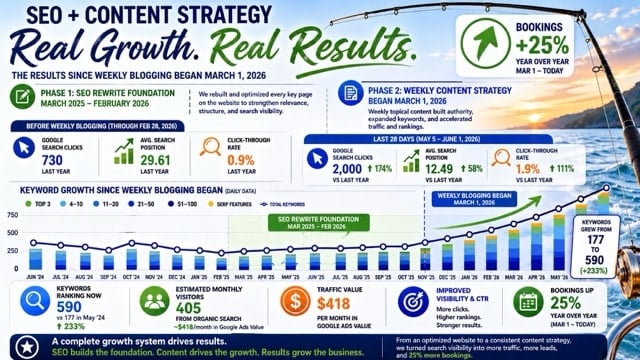
In the 90 days ending May 31, the website generated 2,000 clicks from Google Search, compared to 730 clicks during the same period last year. Their average search position improved from 29.61 to 12.49. Their click-through rate improved from 0.9% to 1.9%.
In May alone, they received 457 Google Search clicks, compared to 186 during May last year. Their average position improved from 31.4 to 15.1, and their click-through rate increased from 0.6% to 1.4%.
Those are strong SEO results. But the most important number was not a search metric.
Bookings increased 25% year over year.
That is the difference between SEO activity and business growth.
Why Businesses Invest in SEO
Most businesses do not invest in SEO because they love rankings reports. They invest because they want more customers. Rankings, clicks, impressions, and keyword growth matter because they are indicators of opportunity, but they are not the business outcome by themselves.
A strong SEO growth strategy helps a business become easier to find when potential customers are already searching. That matters because search traffic often carries intent. People are not being interrupted by an ad while doing something else. They are looking for an answer, a provider, a service, or a solution.
That is why SEO remains one of the best long-term marketing investments for service businesses. When the right pages rank for the right searches, the website becomes more than an online brochure. It becomes a business development asset.
Good SEO creates visibility. Great SEO supports revenue.
What SEO Actually Accomplishes
SEO is very good at increasing visibility in search results. It helps Google better understand what a business does, where it operates, who it serves, and why its pages deserve to appear for relevant searches. When the structure, content, and technical foundation are aligned, a website can begin earning traffic from far more search terms than it did before.
That happened in this client’s case. At the end of May last year, the site ranked for 177 keywords. By the same point this year, it ranked for 590 keywords. That is more than triple the keyword footprint, giving the business far more opportunities to appear in front of potential customers.
The site also gained more top-three keyword rankings, which matters because higher positions capture more attention and more clicks. The improved visibility was not theoretical. Semrush estimated the current keyword set could bring in about 405 visitors per month, traffic that would cost approximately $418 per month to replace with Google Ads.
That is the compounding value of SEO.
A paid ad disappears when the budget stops. A strong organic search presence can keep working.
The Problem With Traffic-Only Thinking
The mistake many businesses make is assuming traffic automatically equals growth. It does not.
Traffic creates opportunity, but the website still has to convert that opportunity. Visitors have to understand the offer, trust the business, find the information they need, and take the next step. If the website fails to guide them, the traffic leaks away.
Most businesses do not have a traffic problem. They have a conversion problem that traffic is exposing.
This is why SEO alone is not enough. A business can move from page three to page one, double its clicks, and still miss growth opportunities if the website is unclear, the calls to action are weak, or the follow-up process depends too heavily on manual effort.
SEO gets people to the door. The Growth System helps them walk through it.
The Three Components SEO Cannot Solve Alone
A complete Growth System includes more than search visibility. It connects SEO, conversion focused website, lead capture, and follow-up into one coordinated process.
Website Conversion Optimization
The website has to make the next step obvious. A visitor should quickly understand what the business offers, why it is credible, and how to take action. That does not happen by accident. It requires clear messaging, useful content, trust signals, strong page structure, and calls to action that match the visitor’s intent.
For this client, the February rewrite mattered because it improved more than keyword targeting. It improved the way the business presented itself to potential customers. The content became more aligned with what people were searching for and more useful once they arrived.
A website should not simply receive traffic. It should help turn interest into action.
Lead Capture Systems
Not every visitor is ready to buy immediately, but interested prospects still need a clear path forward. That may be a form, phone call, booking option, quote request, or another conversion point. The key is making it easy for visitors to raise their hand.
A business should not make potential customers work hard to become leads. If someone arrives from Google with interest, the website should reduce friction, answer common questions, and make the next step feel natural.
Marketing Automation and Follow-Up
Even strong leads can be lost without timely follow-up. This is where many businesses quietly lose revenue. A prospect fills out a form, calls after hours, asks a question, or starts comparing options. If the response is slow or inconsistent, another business may win the opportunity.
Marketing automation helps close that gap. It allows businesses to respond faster, follow up consistently, send reminders, nurture undecided prospects, and stay connected after the first inquiry.
The business that follows up consistently often wins the customer before the business with the best ranking ever gets a second chance.
What a Complete Growth System Looks Like
A Growth System turns disconnected marketing pieces into a coordinated path from visibility to revenue.
SEO attracts qualified visitors. The website converts those visitors into leads. Automation follows up with those leads and keeps the business present until the prospect is ready to act. Measurement then shows what is working, what needs improvement, and where future effort should go.
That is why the client’s result matters. The SEO work increased visibility. The weekly blog strategy expanded keyword reach. The improved content supported better engagement. The business saw a measurable increase in bookings.
SEO generated the opportunity. The system helped turn that opportunity into growth.
Signs Your Business Needs More Than SEO
If your rankings are improving but leads are not, SEO may not be the problem. The problem may be what happens after the click.
You may need a more complete Growth System if your website traffic is increasing but inquiries remain flat, if leads are coming in but not being followed up quickly, if your website does not clearly explain why someone should choose you, or if you cannot connect marketing activity to actual business results.
These problems are common, especially for service businesses. The owner sees traffic moving up and expects revenue to follow. Sometimes it does. Often, the rest of the system has to be strengthened first.
Building an SEO-Focused Growth System
The best SEO strategies are not built around rankings alone. They are built around business outcomes.
For a business owner, the real question is not, “How many keywords do we rank for?” The better question is, “Are we becoming more visible to the right people, and are more of those people becoming customers?”
That shift changes the entire strategy.
Content is no longer created simply to fill a blog. It is created to capture search demand, answer buyer questions, support service pages, and create more paths into the website. Website pages are no longer written simply to describe services. They are written to help prospects understand value and take action. Automation is no longer treated as a separate tool. It becomes part of the customer journey.
SEO generates opportunities. Growth Systems generate customers.
That is the difference between chasing traffic and building growth.
For this client, the combination of SEO rewrites and consistent seasonal content helped increase search clicks, improve average rankings, expand keyword visibility, and contribute to a 25% year-over-year increase in bookings.
That is the kind of result business owners actually care about.
Not rankings for the sake of rankings.
Not traffic for the sake of traffic.
Growth.