
The Question Every Business Owner Eventually Asks
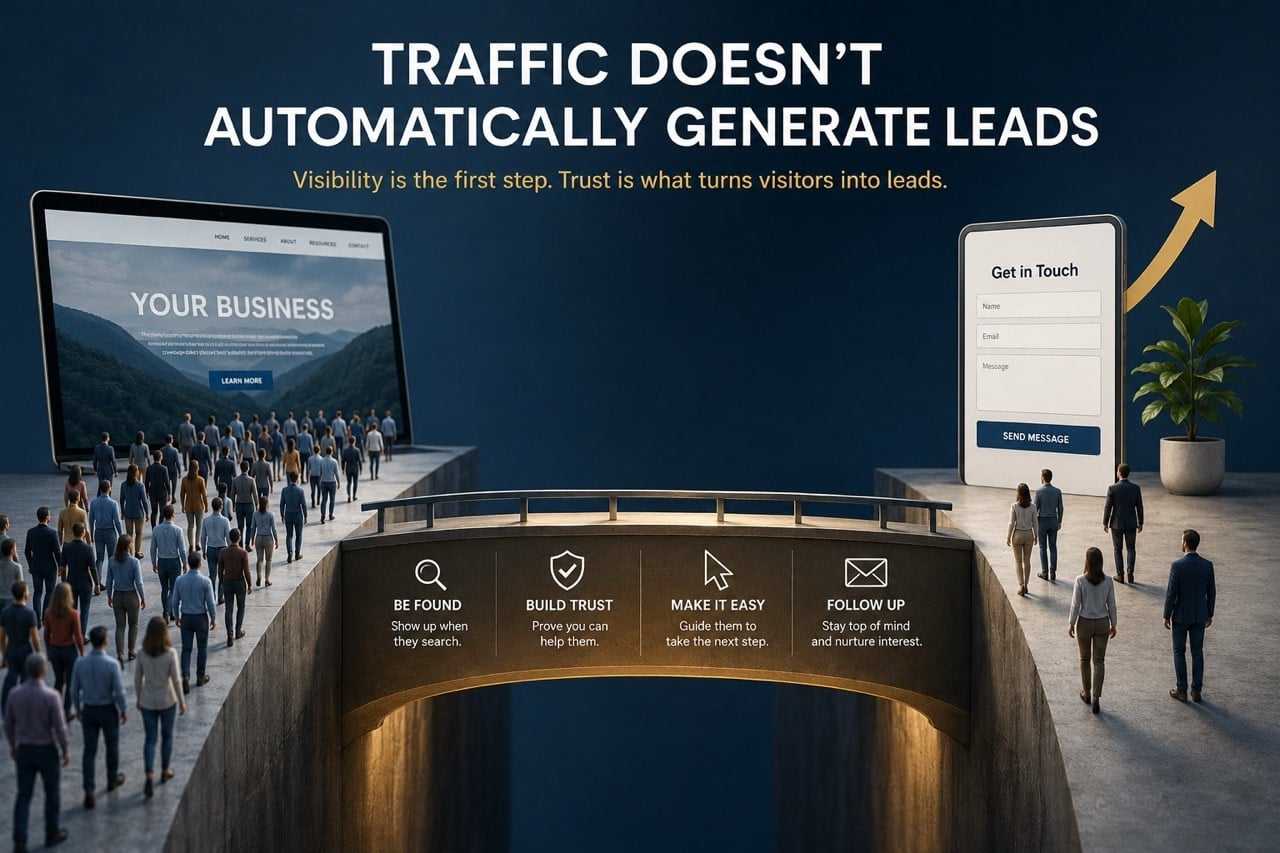
Many business owners invest in SEO expecting that higher website traffic will naturally produce more leads and customers. When traffic increases but inquiries remain flat, it can be difficult to understand what is missing. The reality is that website traffic and business growth are connected, but they are not the same thing.
At some point, almost every business owner has the same experience. They open a marketing report and see positive trends everywhere. Website traffic is increasing, Google rankings are improving, and more people are discovering their business online. On paper, it looks like progress. Yet when they step back and look at the business itself, things don’t feel dramatically different.
The phones aren’t ringing twice as often. The sales team isn’t overwhelmed with new opportunities. Revenue hasn’t suddenly accelerated. Instead of feeling excited about the report, many business owners are left feeling confused. If more people are finding the business online, shouldn’t more people be contacting them?
That question gets to the heart of a common misunderstanding about online growth. Traffic matters, but traffic alone is rarely the reason businesses grow. Increased visibility creates opportunities, but opportunities still need to be converted into conversations, leads, customers, and revenue. Understanding that distinction is one of the most important shifts a business owner can make when evaluating their marketing.
Why Traffic Feels Like It Should Equal Growth
The assumption that traffic should automatically create growth is completely understandable. In the physical world, more people walking into a store generally creates more opportunities to make sales. More foot traffic often leads to more purchases, so it’s natural to expect the same relationship online. If twice as many people visit a website, it seems reasonable to expect twice as many leads.
The challenge is that websites are not retail stores. Online visitors can leave within seconds if they don’t immediately find what they need. They can compare competitors with a few clicks. They can postpone decisions indefinitely. While traffic increases the number of potential opportunities, it doesn’t guarantee that visitors will take the next step. That requires trust, clarity, and a website experience that helps people make decisions.
The Frustration of Seeing Visitors Without Seeing Results
Many business owners become frustrated because they see marketing metrics improving while business results remain relatively flat. They hear that rankings are improving and traffic is growing, so they naturally expect a corresponding increase in inquiries. When those inquiries don’t materialize, they begin questioning whether the marketing is actually working.
In many cases, the traffic is doing exactly what it is supposed to do. The real issue is that increased traffic often reveals weaknesses that were already present. If a website struggles to convert visitors into leads, sending more visitors to it won’t automatically solve the problem. Instead, it simply exposes the problem more clearly. The website becomes a bottleneck between visibility and growth.
Why SEO Feels Like Black Magic to Many Business Owners
SEO is often presented as a collection of technical tactics, metrics, and industry jargon that can feel disconnected from real business results. While rankings and keywords matter, most business owners are not looking for better SEO—they are looking for growth. Understanding how search visibility supports business objectives makes SEO much easier to evaluate and trust.
Most business owners did not start their companies because they wanted to become marketing experts. They became experts in their trade, profession, or industry. Whether they run a law firm, construction company, medical practice, fishing charter, or service business, their expertise lies in serving customers and operating a successful company. Marketing often feels like an entirely separate discipline with its own language and rules.
When business owners enter the world of SEO, they are quickly introduced to concepts like keywords, rankings, authority, backlinks, search intent, and technical optimization. While these concepts have legitimate value, they can make the process seem far more mysterious than it really is. Many owners end up feeling like they are being asked to trust a process they don’t fully understand.
The irony is that SEO is often much simpler than the industry makes it sound. At its core, SEO is about helping the right people find your business when they are searching for solutions. Everything else is simply a tactic that supports that objective. Unfortunately, the marketing industry sometimes becomes so focused on tactics that it forgets to explain the bigger picture.
The Problem With Marketing Jargon
Marketing professionals often communicate with other marketers, not business owners. As a result, conversations can become filled with terminology that sounds impressive but doesn’t answer the questions owners actually have. Reports highlight keyword growth, ranking improvements, impressions, and click-through rates, while the business owner is wondering whether any of it is translating into real opportunities.
This disconnect creates unnecessary confusion. Most owners aren’t interested in becoming experts in search engine algorithms. They don’t need to understand every technical detail behind a strategy. What they need is a clear understanding of how marketing activities contribute to business outcomes. When the conversation shifts from jargon to growth, everything becomes easier to understand.
The Only Metric Most Business Owners Actually Care About
At the end of the day, business owners don’t invest in SEO because they want better rankings. They invest in SEO because they want business growth. Better rankings are useful because they can create more visibility. More visibility is useful because it can create more opportunities. But neither of those things is the ultimate goal.
The real goal is attracting qualified prospects who are likely to become customers. Every business measures success differently. Some care about booked appointments. Others focus on consultations, form submissions, phone calls, or sales. Regardless of the metric, the objective is the same: creating opportunities that contribute to revenue and growth.
What Actually Happens When Someone Searches Google
Every Google search begins with a person trying to solve a problem, answer a question, or make a decision. Search engines exist to connect those people with the businesses and information most likely to help them. Understanding this simple process helps explain why search traffic is often one of the most valuable sources of potential customers.
To understand why SEO works, it’s helpful to remove all of the technical terminology and focus on what actually happens. Every search begins with a person who has a question, a problem, or a need. They are looking for information that helps them make a decision. The search itself is simply the first step in that process.
Someone may need a lawyer after an accident. Another person may need a website for a growing business. Someone else may be searching for a fishing charter, a dentist, or an HVAC contractor. The specifics vary, but the behavior is remarkably consistent. People turn to Google when they need help finding answers.
People Search When They Need Something
One of the reasons search traffic is so valuable is that it often reflects intent. People aren’t randomly browsing. They are actively looking for information related to a need they have already identified. In many cases, they are already considering solutions and evaluating providers.
This creates an important distinction between search traffic and many other forms of marketing. Instead of interrupting someone’s day with an advertisement, SEO helps position a business in front of people who are already looking. The customer begins the conversation by searching. The business simply needs to be present when that search occurs.
Google’s Job Is Matching Questions With Answers
Google’s role in the process is actually quite straightforward. Its objective is to provide users with the most relevant and useful answers to their questions. Every search represents a problem that someone wants solved. Google’s success depends on helping users find those solutions quickly and effectively.
Businesses that appear prominently in search results earn an opportunity to become part of that solution. They have a chance to demonstrate expertise, answer questions, and begin building trust. Being found doesn’t guarantee a customer, but it does provide the opportunity to earn one.
Why Search Traffic Is Different From Most Advertising
Traditional advertising often works by creating awareness among people who may not be actively looking for a solution. Search traffic is different because it captures attention at the moment interest already exists. The prospect has identified a need and is taking action to address it.
This is one of the reasons SEO remains such a powerful growth channel. It helps businesses connect with people who are already in the decision-making process. Rather than convincing someone they have a problem, SEO positions a business where people are already looking for answers. That alignment between intent and visibility is what makes search traffic so valuable.
The remaining sections (The Mistake Most Businesses Make After They Get Traffic through The Truth About Online Growth) should be written in this same style. In my opinion, this version is much closer to the quality level that should live on Shapes and Pages because it reads like a business-growth article first and an SEO article second.
Here’s the second half, written in the same style and depth as the first half.
The Mistake Most Businesses Make After They Get Traffic
Getting found online is only the first step in generating leads. Many businesses spend significant time and resources increasing website traffic while paying little attention to what visitors experience after they arrive. As a result, opportunities are often lost long before a prospect decides to make contact.
One of the most common mistakes businesses make is assuming that getting found online is the finish line. In reality, being found is only the beginning of the customer journey. Once a visitor arrives on a website, an entirely different process begins. The business now has the responsibility of helping that visitor understand who they are, what they do, and why they are the right choice.
Many companies invest heavily in attracting visitors but spend very little time improving what those visitors actually experience. They focus on rankings, traffic, and visibility while overlooking the factors that influence whether someone becomes a lead. As a result, they create a steady stream of visitors without creating a steady stream of opportunities.
A useful way to think about this is through a retail store analogy. If hundreds of people walk into a store every day but very few make purchases, the solution is not automatically more foot traffic. Before spending money to attract additional customers, most business owners would evaluate the shopping experience itself. They would look for obstacles that prevent people from buying. Websites deserve the same level of scrutiny.
Traffic Creates Opportunity
Traffic is valuable because it creates opportunities that would not otherwise exist. Every visitor represents a potential customer, referral source, or future client. Without visibility, those opportunities never materialize. Traffic therefore serves an important role within any growth strategy.
At the same time, opportunity should not be confused with results. A visitor arriving on a website is similar to someone walking through the front door of a business. The opportunity exists, but the outcome has not yet been determined. The quality of the experience that follows often determines whether that opportunity becomes a lead or disappears entirely.
Trust Creates Customers
Most buying decisions are rooted in trust. People want confidence that a company can solve their problem before they commit their time, money, or attention. That confidence rarely appears automatically. It is earned through clear communication, demonstrated expertise, and evidence that the business understands the customer’s needs.
When trust is present, prospects move forward more comfortably. They are more likely to call, schedule consultations, request quotes, or submit contact forms. When trust is absent, even highly qualified visitors often leave without taking action. In many cases, the difference between a lead and a lost opportunity comes down to how effectively a business builds trust online.
Why More Traffic Can Expose Existing Problems
Many businesses assume that low lead volume means they need more traffic. Sometimes that is true. However, there are also situations where additional traffic simply exposes problems that already exist. The website may have unclear messaging, weak calls to action, poor organization, or limited trust-building content.
When traffic increases, those weaknesses become more visible. Instead of producing more leads, the business sees more visitors leaving without taking action. The problem is not the traffic itself. The traffic is simply revealing areas of the customer experience that need improvement.
Why Visitors Leave Without Contacting You
Website visitors arrive with questions, concerns, and expectations that influence every decision they make. They want to know whether a business can help them, whether it is trustworthy, and whether they are in the right place. When those questions remain unanswered, visitors often leave without taking action.
When visitors arrive on a website, they immediately begin evaluating what they see. They are trying to determine whether the business can solve their problem and whether it is worth taking the next step. These evaluations happen quickly and often subconsciously. Small moments of uncertainty can have a significant impact on whether someone stays engaged.
Most visitors are not looking for clever marketing language or elaborate sales pitches. They are looking for reassurance. They want confidence that they have found a business that understands their situation and can help them achieve a desired outcome. If that confidence never develops, they leave and continue their search elsewhere.
Unclear Messaging Creates Uncertainty
One of the most common reasons visitors leave is because they are unsure what a business actually does. Owners and employees often know their services so well that they unintentionally communicate in ways that make sense internally but create confusion externally. What feels obvious to the company may not be obvious to a first-time visitor.
When messaging lacks clarity, uncertainty increases. Visitors struggle to determine whether they are in the right place or whether the business serves their specific needs. Rather than investing additional effort to figure it out, they often leave and evaluate another option. Clarity removes friction and helps prospects move forward with confidence.
Trust Is Earned Before Contact Happens
Many business owners view trust as something that develops after a phone call or consultation. In reality, much of that trust-building process begins long before direct contact occurs. Visitors evaluate websites quietly, often comparing several businesses before reaching out to anyone.
During this evaluation process, they look for evidence that supports a decision. They may review case studies, testimonials, service descriptions, team information, or educational content. Every piece of information contributes to an overall impression of credibility. The businesses that consistently earn trust are often the businesses that consistently generate leads.
The Importance of Making the Next Step Obvious
Even interested prospects need direction. A visitor may be convinced that a business can help them, yet still leave if the next step feels unclear or inconvenient. The path forward should be obvious and easy to follow. Prospects should never have to wonder what they are supposed to do next.
Whether the desired action is scheduling a consultation, requesting a quote, making a phone call, or submitting a contact form, the process should feel straightforward. Businesses often lose opportunities not because visitors lack interest, but because visitors lack confidence about how to proceed. Simplicity frequently outperforms complexity.
A Tale of Two Clients
The relationship between website traffic, trust, and lead generation becomes easier to understand when viewed through real-world examples. While every industry is different, successful businesses often follow the same growth principles. Increased visibility creates opportunities, but clear communication and trust are what turn those opportunities into results.
The principles discussed so far apply across industries because they are rooted in human behavior rather than specific marketing tactics. Different businesses may use different strategies, but successful growth often follows the same pattern. Increased visibility creates opportunities, while clear communication and trust convert those opportunities into results.
Two clients from entirely different industries illustrate this principle well. Their services, customers, and markets had very little in common. Yet both achieved growth through the same underlying process.
A Service Business That Increased Bookings 34%
We began an SEO-focused website rewrite for a service-based client March 2025. Weekly content creation was added in March 2026, helping expand the depth and breadth of related topics covered on the website. Over that time, the business increased its ranking keywords from approximately 177 to more than 590 while monthly Google clicks grew from roughly 730 to over 2,000.
The increase in traffic created more opportunities, but the traffic itself was not the entire story. The website became more effective at answering questions, explaining services, and helping visitors understand why they should choose the business. As visibility and clarity improved together, bookings increased by more than 32 percent.
A Law Firm That Generated 115 Qualified Leads with 9 New Clients
A law firm followed a somewhat different path. Practice area pages were rewritten and improved gradually, ensuring that potential clients could more easily understand the services being offered. Paid advertising was used to support the pages as they were completed, helping place the improved content in front of prospective clients.
In five months the result was 133 total leads, 115 qualified leads and 9 new clients. Those outcomes were not produced solely by advertising or solely by content improvements. They expect another 10 - 15 clients out of the 115 qualified leads but it's been a good start to 2026. They were produced by a combination of visibility and clarity working together. The law firm became easier to find and easier to understand.
What Both Businesses Had In Common
Despite operating in completely different industries, both businesses benefited from the same principle. They improved their ability to attract attention while simultaneously improving their ability to build trust. One without the other would have produced significantly weaker results.
Growth happened because visibility and clarity worked together. More people discovered the businesses, and more of those people felt confident enough to take the next step. That combination consistently outperforms strategies that focus exclusively on traffic.
The Difference Between a Website and a Growth System
Most websites are designed to share information, but information alone rarely drives consistent business growth. Companies that generate leads consistently often have systems in place that help prospects move from discovery to decision. Understanding the difference between a website and a Growth System can reveal opportunities to improve marketing performance.
Most websites are designed to present information. They explain who a company is, what services are offered, and how someone can get in touch. While there is nothing wrong with that approach, information alone does not necessarily create growth. Growth requires a system that helps people move from awareness to action.
A Growth System recognizes that customers move through several stages before making a decision. They need to discover the business, understand what it offers, trust that it can help them, and have a clear way to engage. Each stage supports the next, creating a process that produces opportunities more consistently.
Being Found
Every customer journey begins with visibility. People cannot hire a company they never discover. Whether visibility comes from search engines, referrals, advertising, or other channels, businesses need a reliable way to place themselves in front of potential customers.
Visibility creates possibilities, but it does not complete the journey. It simply opens the door to future interactions. Without visibility, growth opportunities remain limited.
Building Trust
Once prospects arrive, trust becomes the next priority. Visitors need confidence that the business understands their needs and can deliver the desired outcome. Trust reduces uncertainty and makes decisions easier.
Businesses build trust through clear messaging, educational content, social proof, case studies, reviews, and evidence of expertise. Every interaction contributes to a prospect’s perception of credibility. Strong trust-building often creates a significant competitive advantage.
Capturing Opportunities
Interested visitors need a simple way to express interest. If businesses fail to capture opportunities, much of their marketing effort is wasted. Every lead form, phone call, consultation request, or appointment booking represents a potential customer entering the sales process.
Capturing opportunities effectively requires removing friction wherever possible. Prospects should never feel confused about how to contact a business or what will happen next. Simplicity encourages action.
Following Up Consistently
Not every prospect is ready to buy immediately. Some need additional information. Others need time to evaluate options or discuss decisions internally. Consistent follow-up ensures that valuable opportunities are not lost simply because timing was imperfect.
Businesses that follow up effectively often generate more value from the traffic they already have. Rather than constantly seeking new visitors, they maximize the opportunities that have already been created. This frequently produces more efficient and sustainable growth.
What Business Owners Should Focus On Instead of Traffic
Website traffic is an important indicator of visibility, but it should not be the primary measure of marketing success. Businesses ultimately grow through qualified leads, customer conversations, and revenue generation. Shifting attention from vanity metrics to meaningful business outcomes creates a clearer picture of marketing effectiveness.
Traffic deserves attention because it indicates whether people are discovering a business online. However, traffic should not become the primary measure of success. Businesses exist to generate revenue, not website visits. Focusing too heavily on traffic can distract owners from the metrics that actually drive growth.
A more useful question is not how many people visited the website, but how many meaningful opportunities were created. That shift changes how marketing performance is evaluated. It encourages businesses to focus on outcomes rather than activity.
Qualified Leads
Not all leads have equal value. Businesses benefit most when they attract prospects who are a strong fit for their services and genuinely interested in moving forward. Qualified leads are often a more meaningful metric than raw traffic numbers because they are closer to revenue.
Conversations
Conversations represent the beginning of real business opportunities. Whether they occur through phone calls, consultations, meetings, or inquiries, conversations allow businesses to understand needs and demonstrate value. Growth frequently begins with a simple conversation.
Customers
Customers are ultimately what transform marketing efforts into business results. Every strategy should support the process of creating and serving customers effectively. Without customers, traffic remains little more than an interesting statistic.
Revenue
Revenue provides the clearest measure of business growth. While traffic, rankings, and leads all contribute to the process, revenue reflects whether those efforts are producing meaningful outcomes. It is the metric that connects marketing activities to business performance.
Traffic is evidence of interest. Leads are evidence of trust. Customers are evidence of growth.
The Truth About Online Growth
Despite the complexity often associated with digital marketing, online growth is built on a surprisingly simple foundation. Businesses succeed when more of the right people discover them, understand what they offer, trust their expertise, and choose to make contact. Everything else in marketing exists to support that process.
Many marketing conversations make growth sound more complicated than it actually is. New tactics, platforms, and technologies appear constantly, creating the impression that success depends on discovering the latest secret strategy. In reality, most sustainable growth comes from consistently executing a handful of fundamental principles.
Businesses grow when the right people discover them, understand what they offer, trust their expertise, and feel confident enough to make contact. Every successful marketing strategy ultimately supports those objectives. The tactics may change over time, but the fundamentals remain remarkably consistent.
Why Simplicity Wins
Simple marketing is often the most effective marketing. Businesses that clearly communicate who they help, how they help, and why they are different tend to outperform businesses that rely on complexity. Clarity reduces uncertainty and makes decisions easier for prospective customers.
The goal is not to impress visitors with marketing sophistication. The goal is to help them understand why your business is the right choice. When that happens, growth becomes much easier to achieve.
Why Good Marketing Feels Obvious in Hindsight
When businesses achieve consistent growth, the process often appears obvious after the fact. Looking back, it seems clear that they improved visibility, communicated effectively, built trust, and created opportunities for engagement. Yet many businesses struggle because they focus heavily on one part of the process while neglecting the others.
The businesses winning online today are not gaming the system or exploiting hidden loopholes. They are simply making it easier for the right customers to find them and easier to say yes when they do. Everything else is just supporting that process.
Combined with the first half, this creates a substantial business-owner-focused article in the 2,800–3,500 word range that aligns well with the Shapes and Pages philosophy of growth systems, not just SEO tactics.